This article combines the main finding from a 2026 research paper with real-world field observations. Follow the link below to read the full study.
Genetic structure of traditional cacao reveals four new genetic lineages in indigenous Amazonian sites in Peru
https://doi.org/10.1371/journal.pone.0351690
Quick summary, the study classified the genetic family of native cacao in Peru. The authors suggested 4 clusters can be sorted based on their geographical region, each region has its own distinct genetic composition. Within the 4 clusters, two of them are in La Convencion: Chuncho 1, mainly from Urubamba valley, and Chuncho 2, mainly from VRAEM.
Let’s set up the background for these terms first, in another article we talked about the geography of La Convención, we know that there are two main valleys run through the province: the Urubamba valley and the VRAEM, they were formed by two water systems. Though the direct distance of the two valleys is only 180km, the mountains in between make the total travel time to 10 hours by truck in the modern days; it might have taken days in the past. We can confidently say that because of the geographical barrier the native cacao in each valley developed independently without much interaction between them.
We now have data showing that cacao from the two valleys is genetically distinct. Let’s look at these two cacao families from a farmer’s perspective. To keep things clear, I use names consistent with local usage across this site: Chuncho is the native cacao related to the Urubamba family, and VRAE is the cacao family related to the VRAEM region. I don't follow the study's numerical naming system.
The Chuncho Cacao Family (Urubamba Valley)
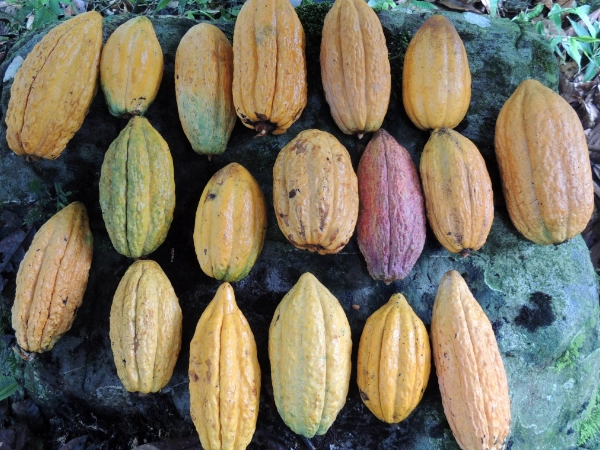
Chuncho is a word derived from Quechua used to describe cacao from the Cusco jungle, though it isn't strictly defined or scientifically researched. When you see this term, it's best understood simply as native cacao from Cusco. It represents a family with broad genetic diversity, meaning you won't find a single "typical" flavor profile across Chuncho chocolate unless the beans are sourced from the exact same farm. You might try a mild, fruity dark chocolate or a harsh, spicy one that both use Chuncho cacao. We don't yet have enough research to map all of Chuncho’s traits, nor do we have standardized post-harvest processing. Most of the farms plant the trees from seeds then they select the ones with good results. Each farm has their own selection criteria to achieve the flavor they like. Therefore, each lot of cacao chucho is not one variety, it represents the genetic pool of that farm.
Tips on Sourcing Cacao Chuncho
Remember that you'll encounter vastly different flavor profiles even when everything is labeled as Cacao Chuncho. Your best bet is to visit the origin in person and taste them until you find what you love.
The VRAE Cacao Family (VRAEM Basin)
The VRAE family also has wide genetics, but more strain identification has been done here. Strains with good flavor and disease resistance have been identified, and clones are shared with other farms. Some of the strains you see on the market are VRAE-99, VRAE-52, VRAE-15, and Bella Vista. You can expect a consistent flavor profile when tasting chocolate made from the same strain (e.g., VRAE-99), even across different chocolate manufacturers. In addition to these well-established strains, there is still a lot of native cacao in the region that hasn’t gone through the identification process; it all falls under the name native cacao.
Tips on Sourcing Cacao from VRAEM
For established strains, it is safe to order online after tasting samples. The flavor profile won’t vary too much between farms. Overall production is higher, and some cooperatives accept orders of up to one container. For lesser-known native strains, you will still need to come to the origin to check the flavor profile and production situation.
Conclusion: Matching Terroir to Your Chocolate Profile
The native cacao from both valleys is native Peruvian cacao with a fine aroma, and both have won various international prizes. From my own experience, VRAE-99 is well-established and can be used to produce craft chocolate in higher quantities. On the contrary, Chuncho is more of an adventure, the results can be unexpected. With lower production and higher variability, it’s better suited for limited editions each year.