While the mainstream coffee and cacao industry is always coming up with new methods to help to boost the yield, local farmers tend to stay with their ancestral wisdom in farming. It turns out that the “new” methods promoted by the industry, e.g. shade-grown, is actually an ancient concept here that many farmers take as a “common sense”. In this article, let’s talk about how the local farmers utilize their ancestral knowledge in their agriculture.
The Andean Side: Vertical Altitudinal Control
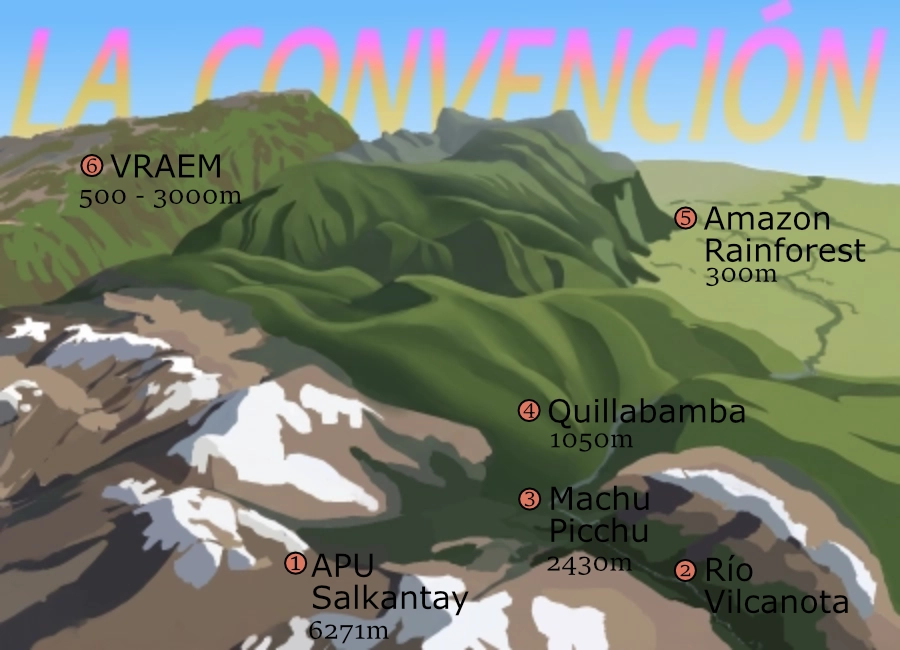
Andean civilizations mastered agriculture by treating steep mountain terrain as a vertical staircase of distinct microclimates—a strategy known as the "vertical control of ecological floors." Because temperature and humidity shift dramatically with elevation, traditional farmers matched crops to the altitude where they thrived naturally: frost-hardy tubers like potatoes and native grains like quinoa were cultivated in the frigid high-altitude puna (above 3,000 meters), maize occupied the temperate mid-altitude valleys, and heat-loving crops like coca, fruit, and cacao were grown on the warmer, lower slopes. This is a unique trait of Andean cultures: in other parts of the world, people usually see mountains as a challenge; however, Andean cultures see steep slopes as opportunities.
The current farmers in La Convención also face the challenge of steep slopes as their ancestors.
For coffee, they grow different varieties based on the microclimates within the farm. For example, they developed a system to plant Gesha at higher altitudes for its exotic floral flavor, and Catimor at lower altitudes to maximize yield while maintaining a stable flavor profile.
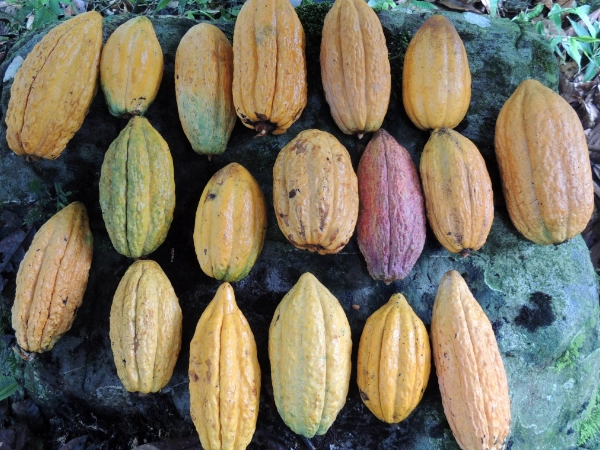
For cacao, since Peru has a diverse genetic base, farmers select strains that thrive at different altitudes. The local Chuncho family, in particular, can survive at higher altitudes due to generations of human selection.
The Amazonian Side: Multi-Tiered Agroforestry
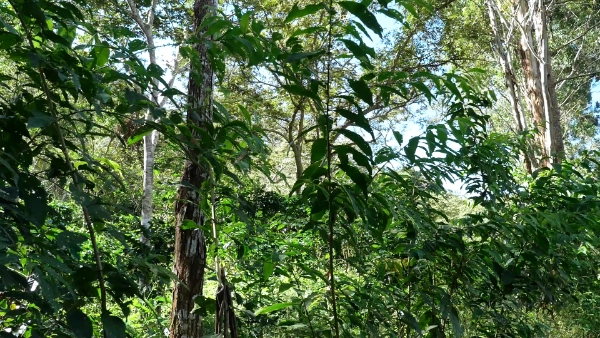
Amazonian cultures mastered jungle farming by cultivating crops within the living forest rather than clearing it. This traditional practice is known as agroforestry. Because fragile tropical soils rapidly lose their nutrients when exposed to heavy rains and intense sunlight, indigenous farmers designed multi-layered forest gardens that mimic the natural ecosystem. Shade-tolerant crops like native cacao are interplanted beneath tall canopy trees, fruit trees, and nitrogen-fixing plants. By maintaining this multi-tiered canopy, Amazonian communities naturally protect the soil from erosion, preserve vital moisture, and sustain rich biodiversity without needing synthetic inputs, they let the organic matter circular naturally.
A typical farm here uses pacay, avocado, or pisonay as a first layer to provide filtered shade. They then sprinkle in other economic trees as a second layer to add diversity, such as plantain, banana, citrus fruits, or cacao.
Combining the Two Systems at Origin
This isn't a simple 1 + 1 = 2 equation. Combining these two concepts is by no means easy, especially when most of the farms are on steep slopes. For example, to add banana trees to a farm, a farmer needs to find varieties that adapt well to different altitudes. If they add a variety that doesn't work well with the rest of the system, one plus one might end up being less than two. Applying these two concepts in the field relies on generational knowledge accumulated by their ancestors—no wonder they produce award-winning coffee and cacao.